
- Best Overall: Compact brushless 18V/20V drill/driver — Most people doing mixed DIY and home repair
- Best for Heavy Work: Hammer drill/driver (brushless, high-torque) — Decking, masonry anchors, lag bolts
- Best Value: Brushed 18V/20V drill/driver kit — Occasional DIY and around-the-house tasks
- Best Compact / Light-Duty: 12V subcompact drill/driver — Tight spaces, light assembly, travel kit
A good cordless drill is the one tool almost every household actually uses. We evaluated brushless and brushed drill/drivers across the metrics that matter day to day: usable torque, battery runtime, chuck quality, weight and balance, and long-term value of the battery platform you buy into. Below are our category winners, what separates a great drill from a frustrating one, and how to choose the right class for your projects.
Our top picks
We chose these based on the criteria below. Product types are described generically so the advice stays useful across brands and model years; see each pick on Amazon for current pricing and availability.
Compact brushless 18V/20V drill/driver
Best for: Most people doing mixed DIY and home repair ·
What we like
- Brushless efficiency gives long real-world runtime
- Compact head fits tight cabinets and joist bays
- Two-speed gearbox and a precise clutch
- Huge battery-platform tool support
Watch-outs
- Premium kits cost more up front
- Bare tool tempting but you still need batteries
The sweet spot for value and capability.
 Best Overall: DEWALT 20V MAX XR Brushless Compact Drill/Driver Kit
View on Amazon → Check price on Amazon → Sponsored link · we may earn a commission
Hammer drill/driver (brushless, high-torque)
Best for: Decking, masonry anchors, lag bolts ·
What we like
- Hammer mode handles brick and concrete anchors
- 500+ in-lb class torque for big fasteners
- Robust all-metal chuck
Watch-outs
- Heavier and bulkier than a compact drill
- Overkill for hanging pictures
Buy this only if masonry or framing is on your list.
 Best for Heavy Work: DEWALT 20V MAX XR Brushless Hammer Drill Combo
View on Amazon → Check price on Amazon → Sponsored link · we may earn a commission
Brushed 18V/20V drill/driver kit
Best for: Occasional DIY and around-the-house tasks ·
What we like
- Lowest cost of entry into a real platform
- Plenty of power for shelves, flat-pack and small repairs
- Often bundled with two batteries
Watch-outs
- Shorter runtime and motor life than brushless
- Less torque headroom for big jobs
If you drill a few times a month, this is enough.
 Best Value: DEWALT 20V MAX Drill Driver Kit with 2 Batteries
View on Amazon → Check price on Amazon → Sponsored link · we may earn a commission
12V subcompact drill/driver
Best for: Tight spaces, light assembly, travel kit ·
What we like
- Very light and short — easy one-handed use
- Ideal for furniture assembly and electronics
- Affordable batteries
Watch-outs
- Limited torque for large holes
- Not for masonry or decking
A brilliant second drill or apartment-friendly first drill.
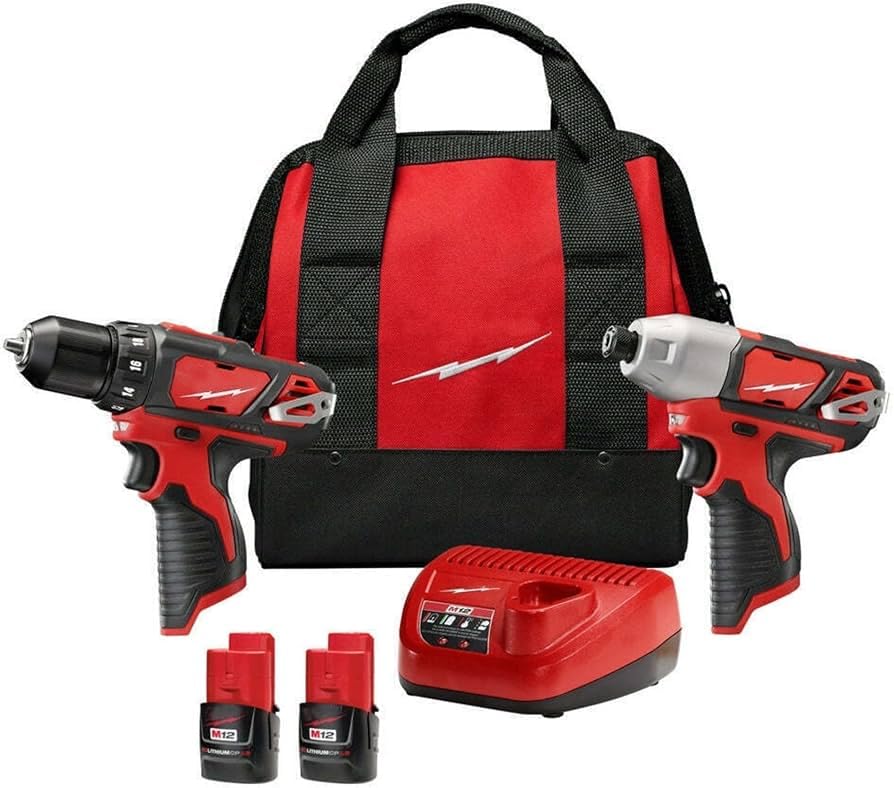 Best Compact / Light-Duty: Milwaukee M12 12-Volt Drill/Impact Driver Combo Kit
View on Amazon → Check price on Amazon → Sponsored link · we may earn a commission
How to choose cordless drills
Before you compare specific picks, weigh up the factors below. They are the ones that genuinely affect how happy you will be in daily use — in roughly the order most buyers should prioritise them.
Brushless vs. brushed motor
Brushless motors run cooler, last longer and squeeze more runtime from each charge. For anything beyond very occasional use, a brushless drill is worth the premium.
Torque (measured in inch-pounds or Nm)
More torque drives larger fasteners and bores wider holes. 300+ in-lb covers most home jobs; 500+ in-lb starts to handle decking and lag bolts.
Battery platform, not just the drill
You are buying into an ecosystem. A mid-range 18V/20V-class platform with wide tool support is usually the smarter long-term decision than a slightly better standalone drill.
Chuck and clutch quality
A 13mm (1/2 in) all-metal keyless chuck grips bits without slipping. A clutch with clear, distinct settings prevents stripped screws and overdriving.
Weight, balance and grip
You hold this overhead and at awkward angles. Sub-3.5 lb bare weight and a grip that suits your hand size reduce fatigue more than any spec sheet number.
Two-speed gearbox
A low/high gear selector lets you choose torque (low) for driving or speed (high) for drilling. It is a feature you will use constantly.
How they compare
Specs and jargon, explained
The terms you will see on spec sheets, in plain English:
| Term | What it means for you |
|---|---|
| Voltage (12V / 18V / 20V MAX) | Roughly indicates power class. '20V MAX' and '18V' are marketing variations of the same nominal pack — compare torque and runtime, not the headline number. |
| Torque (in-lb / Nm) | Twisting force. Higher drives bigger fasteners. 1 Nm ≈ 8.85 in-lb. |
| Chuck size (3/8 in vs 1/2 in) | Maximum bit shank it grips. 1/2 in (13mm) accepts larger drill and spade bits. |
| Amp-hours (Ah) | Battery capacity. A 4.0Ah pack runs roughly twice as long as a 2.0Ah pack on the same tool. |
| RPM | No-load speed. Higher RPM drills faster in wood; you rarely need full speed for driving screws. |